A First Rugby Sevens Match: Follow the Space Between Players
A first rugby sevens match is easier to read when you track open lanes, shifting defensive gaps, and how players move to create or close space.
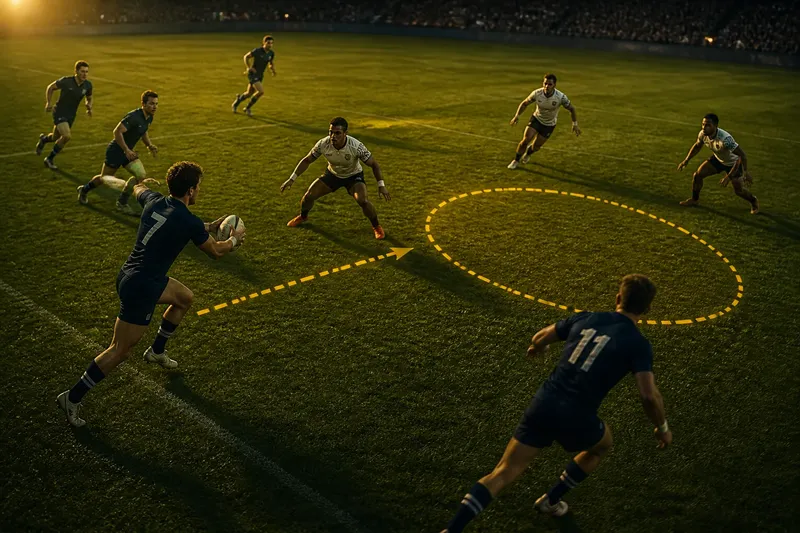
The most common mistake at a first rugby sevens match is watching only the ball; it costs you the story of the next pass and the defenders already moving to close space. A first rugby sevens match becomes easier to follow when your eyes travel from the ball carrier to the gaps between players, then to the defenders reacting to them.
Sevens uses seven players per team, but field dimensions can depend on the competition and its conditions. Rather than assume the playing area is identical everywhere, watch how the players available on each side spread across the field. The gaps shift as they move, so an open patch of grass is only useful if an attacker can reach it before a defender does.
Why does the field look so open?
With fewer players on each side than in fifteen-a-side rugby, the teams have fewer bodies to cover the field. Defenders may spread out, leaving space between them, or gather near the ball and concede room farther away. Attackers try to spot that arrangement and move the ball toward the area with less coverage.
Imagine a team has the ball near the right touchline while several defenders have shifted that way. A teammate passes back across the field to a runner on the left; the observable result is that defenders have to turn and move across, instead of simply closing on the original carrier. The pass changes where the defense must run, not just where the ball is.
A broad field with a small group of players can feel like a room with only a few chairs: empty patches are easy to see, but reaching one still depends on where everyone else is moving. Look at the defenders’ shape before deciding that a patch of grass is safe.
What should I watch when a team attacks?
Start with the ball carrier, then glance one or two players outward. Notice whether teammates run straight at defenders, hold width near the touchline, or arrive behind the carrier as passing options. Those movements ask defenders to choose whom to cover.
Watch the defensive line as well. If a defender steps forward, space may open behind that player or between nearby teammates. If defenders move sideways together, look for the gaps their movement leaves rather than assuming the attack will cut back against them.
Passes may travel backward or sideways while the attack advances. That can look like retreat, but it may draw defenders across and create room farther along the line. Supporting runners’ angles often reveal where the attack is trying to go next.
How do quick transitions change the picture?
A transition is the moment possession changes, such as after a loose ball or turnover. The team that wins the ball may find opponents spread out from their previous shape. The new carrier can look for an opening before those players turn and organize their defense.
When possession changes, briefly widen your view. Ask which players are still moving in the old direction and where the new carrier’s nearest support is. A defender who was chasing an attacker may now be behind the play, leaving a teammate to cover more ground.
Then watch how the team that lost possession responds. If its players close the middle first, space may remain outside; if they fan out, a path may appear through the center. The defense’s movement helps explain why the next pass or run goes where it does.
When does a kick create a different kind of space?
A kick can send the ball behind defenders or make them turn to recover it. Look at the landing area and the players near it, rather than following the ball’s flight alone. Their positions show where the next contest is likely to form.
Notice whether the receiving team has room to gather the ball and move away. If defenders are close, the receiver may have to make a quick decision; if there is more space, teammates may have time to offer passing options. This keeps your attention on how the kick changes the available space, rather than on the details of a chase.
For a first viewing, track the receiver and the nearest defenders. Once the ball is gathered, follow the next pass or run to see whether the contest has opened a lane or compressed the attack.
What should I notice at a restart?
Restarts begin play after a score and can quickly shape the next possession. Watch where the kick travels, which players move toward it, and whether the receiving side gathers the ball cleanly. These movements show which side can organize first around the ball.
After the catch, look for support runners and defenders closing from either side. The receiver may pass to a teammate with more room or carry the ball to draw a defender before releasing it. Notice how the defense’s position affects that choice.
What do viewers often ask about space in sevens?
Why do players spread out so widely?
Spreading out can stretch the defense and create passing lanes between defenders. A wide player may hold space while teammates draw attention nearer to the ball.
Why does a pass go backward when the team is attacking?
Rugby passes must travel backward or sideways, even when the team is advancing. A backward pass can let a teammate catch the ball at speed and attack a gap farther downfield.
Why does a team sometimes kick instead of passing?
A kick can put the ball behind the defensive line or make opponents turn to recover it. Watch where the ball lands and how the players around it are positioned to see what space the kick creates.
What should I follow after a turnover?
Find the new ball carrier, then check which defenders are out of position and where the carrier’s teammates are moving. That quick scan can show which route has room before the defense settles.
How can I make a first match easier to follow?
Choose one team and trace its shape for a few possessions. Notice who stays wide, who supports the carrier, and how players respond when possession changes. Then switch your attention to the defending side and watch how it tries to close the same spaces.
If you can, choose a seat with a view across much of the field, rather than only the near touchline. You do not need to identify every role or call every decision correctly. Keep returning to three questions: where is the open space, who is moving toward it, and which defender must react?
That habit makes a first rugby sevens match feel less like a blur of sprinting and more like a series of choices. When possession changes, look beyond the new carrier: the teammates and defenders moving into position often show where the next opening will appear.