Loosehead and Tighthead: Two Scrum Roles Compared
Loosehead and tighthead roles explained through scrum position: learn how each prop’s place in the front row shapes the contest and what to watch.
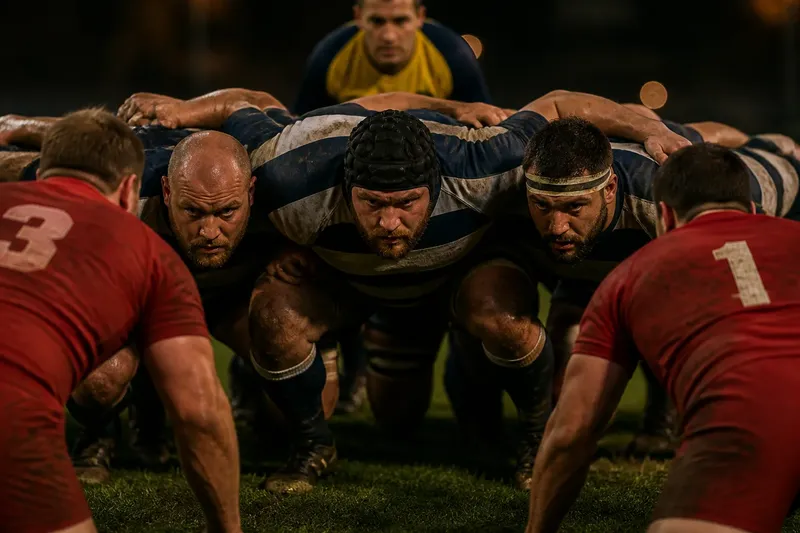
The most common mistake when comparing a loosehead and tighthead is to treat them as mirror-image props with different names. That makes the scrum harder to read: you miss why one prop’s head is outside the opposing tighthead while the other is between two opponents. Loosehead and tighthead roles make sense only when you track each player against the opposing front row.
Here is an invented, hypothetical scrum to make the orientation clear. Harbor has the put-in after a knock-on, and its front row faces the opposing front row; imagine you are looking directly at Harbor from the opposition’s side. Harbor’s loosehead is on the viewer’s right of its hooker, and its tighthead is on the viewer’s left. From Harbor’s own perspective, those sides are reversed.
Loosehead and tighthead roles depend on the opposing front row
At the scrum, Harbor’s loosehead binds against the opposing tighthead, with the loosehead’s head outside that opponent’s shoulder. “Outside” here means on the side away from the opposing hooker. The loosehead’s head is therefore on the comparatively open side of the opposing front row.
Harbor’s tighthead binds opposite the opposing loosehead, with the opposing hooker beside that opposing prop. The tighthead’s head is in the narrower space between the opposing loosehead and hooker. That relationship—not a fixed side of the field or a camera angle—is what the position names describe.
The hooker stands between the two props in each front row. At a televised match, the camera may reverse the apparent left and right, so identify the hooker first, then compare each prop’s head and bind with the opponents directly across from them.
The loosehead manages an outside connection
The loosehead has a comparatively open outside edge, but is still bound against the opposing tighthead and must stay connected to the hooker. The player contributes to the shared forward effort; “open” does not mean unopposed or free to act alone.
In Harbor’s invented scrum, the loosehead keeps a legal bind and stays linked to the hooker as pressure builds. The front row remains connected long enough for the ball to be put in. That observable result does not establish that the loosehead won the contest; the whole pack contributes to the platform.
If the outside shape changes, that is a cue to watch the scrum closely, not proof of an individual mistake. Pressure may be moving elsewhere in the pack, and a single camera view rarely shows every bind and movement.
The tighthead works in a more enclosed space
Harbor’s tighthead faces the opposing loosehead and is positioned between that opponent and the opposing hooker. The tighthead must maintain a controlled connection with the opposing front row while remaining linked to Harbor’s hooker. The role is not simply to push straight ahead: posture, balance, and coordination affect the front row’s shape.
In the invented sequence, the opposing loosehead applies pressure inward while the hooker remains alongside. Harbor’s tighthead maintains the bind, and the front row stays connected. If that connection changes, it may affect the shape of the scrum, but the movement alone does not explain what caused it.
The enclosed position helps explain why spectators often watch the tighthead battle closely. It does not mean the tighthead is automatically the stronger prop or that the position alone decides the outcome. Both props have demanding jobs, and neither can control the scrum without teammates.
The front row shares the work
It is tempting to assign all the attacking work to the loosehead and all the defensive work to the tighthead. That split is too neat. Both props must maintain their binds and support the hooker, while the rest of the pack adds force behind the front row.
Think of the front row like three connected shelves in a bookcase: if one shifts, the load does not stay neatly on that shelf. The comparison is limited because a scrum is a live contest between moving players, but it helps explain why one prop’s posture affects teammates as well as a direct opponent.
Imagine Harbor’s scrum stays connected as its scrum-half gathers the ball and passes to a teammate. The observable result is that Harbor can continue play from the scrum, not that one prop won alone. If instead a bind changes and the referee stops play, watch the signal and the referee’s decision rather than assigning blame from the movement by itself.
What should you watch at a scrum?
Which prop is the loosehead?
Find the opposing tighthead, then look for the prop whose head is outside that player’s shoulder, away from the opposing hooker. Do not identify the loosehead by touchline or screen position, since the camera may reverse the view.
Why is the tighthead more enclosed?
The tighthead’s head is positioned between the opposing loosehead and hooker. That narrower space is the defining positional contrast, though the exact view may be obscured by bodies or camera angle.
Does the tighthead always have the harder job?
No single label settles which role is harder in a particular scrum. The tighthead works in a more enclosed position, while the loosehead also faces a direct opponent and helps maintain the front row’s shape.
What does a turning or collapsing scrum tell you?
It tells you the scrum’s shape or direction changed, but not who caused it. Look for the referee’s signal and the whole pack’s movement; a viewer should not diagnose an infringement from one angle alone.
Follow the bind before judging the outcome
For a simple viewing routine, start with the hooker, then trace each prop’s bind to the opposing front row. Check which prop’s head sits outside the opposing tighthead and which occupies the space between the opposing loosehead and hooker. If the view is unclear, wait for a wider camera angle rather than guessing from screen position.
Loosehead and tighthead roles give you a useful map of the front row, not a shortcut for assigning credit or blame. Watch whether both props remain connected to the hooker as pressure builds, then use the referee’s decision to understand how play resumes.