How the Rugby Advantage Law Works During Open Play
Understand the rugby advantage law by reading the referee’s signal, the available attacking options, and why play may return to the original infringement.

The most common mistake in watching the rugby advantage law is expecting an immediate whistle after every infringement; that can make a deliberate pause look like a missed call. When the referee judges that the non-offending team may benefit from continuing, play can go on while the referee assesses what happens next.
Advantage is a decision made in context, not a fixed countdown or a promise that the team will get a particular result. The referee may allow play to continue, decide that an advantage has been gained, or stop play and award the restart for the original infringement, subject to the applicable law and competition procedures.
The rugby advantage law turns on the benefit available
The referee may let play continue after an infringement so the team that did not offend has a chance to make use of the situation. That benefit might be an attacking opportunity, a useful territorial position, or another practical option. A team does not have to score for advantage to be judged as gained.
The referee considers the type of infringement and what follows it. A brief run forward may create a useful attack in one situation but leave a team trapped under pressure in another. There is no single visible distance or number of passes that settles every decision.
Think of advantage like keeping a door open while checking whether the next room offers a better route. The original restart is not a simple option the team can claim whenever it prefers; the referee decides whether sufficient advantage has been gained or whether play should return to the infringement.
A delayed whistle can be an active decision
A referee may call “advantage” or make a signal while allowing play to continue. The signal indicates that an infringement has been identified and that the referee is assessing what the non-offending team can do. The referee may then whistle if the opportunity does not develop into a sufficient benefit, or indicate that advantage is over if it does.
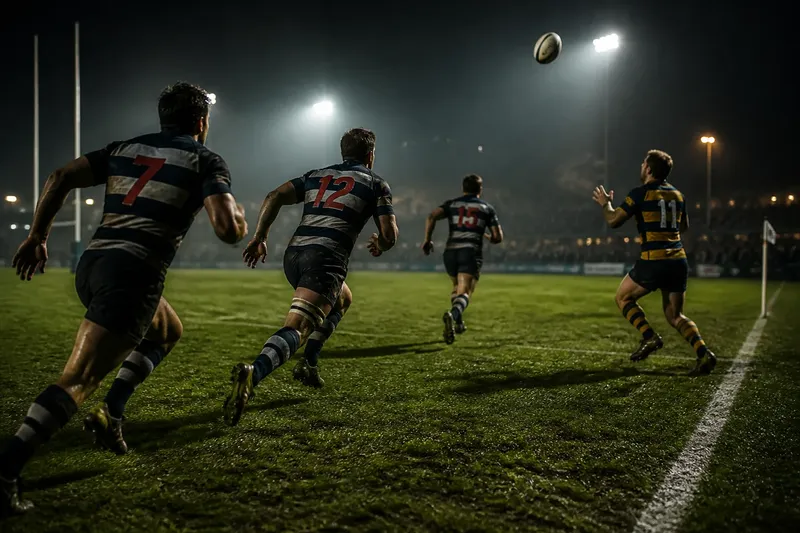
Say an offside infringement occurs as the attacking team moves the ball into open space. The referee signals advantage; the ball carrier advances and draws a defender before passing to a teammate with room to attack. The referee may judge that the team has received a worthwhile opportunity and allow play to proceed without returning to the original penalty. If instead the pass is forced backward and the team is immediately pinned, the referee may decide that no sufficient advantage has resulted and stop play for the appropriate restart.
In either case, watch the team’s options rather than counting seconds. A delayed whistle does not by itself mean the referee failed to see the infringement.
The type of infringement shapes the assessment
The potential restart matters because advantage is judged in the circumstances of the infringement. An infringement that would lead to a penalty and one that would lead to a scrum do not offer the same restart. The referee assesses whether continuing has provided a meaningful benefit in light of what would otherwise follow.
Players can keep attacking, pass, or kick when those choices are available. A kick does not automatically end advantage: the referee still judges whether the team gained a worthwhile result and whether the situation calls for play to continue or return to the original infringement.
Movement alone is not the test. A team may gain ground yet remain unable to use the ball; conversely, it may create a useful attacking option without traveling far. The referee’s judgment concerns the benefit available, not a universal measure of distance.
Check the referee’s signal, the options, and the result
- Check whether the referee signals advantage; if so, watch the non-offending team’s next action, and if not, follow the call actually made rather than assuming advantage is in progress.
- Check whether the infringement would ordinarily produce a penalty or scrum; if the team remains under pressure, expect the referee may judge that the opportunity has not produced sufficient benefit, and if it has a useful option, watch for play to continue.
- Check whether the team has control of the ball; if it cannot use possession, the referee may stop play for the original infringement, and if it can act purposefully, watch the next decision before judging the outcome.
- Check whether the attack has a practical route forward; if defenders close the available space and the team gains no useful alternative, the referee may call play back, and if a clear option remains, play may continue.
- Check whether a kick creates useful territory or leaves the team in trouble; if the result brings no sufficient benefit, the referee may return to the infringement, and if it gives the team a worthwhile position, advantage may be judged over.
- Check for the referee’s signal that advantage is over; if it appears, follow the continuing phase without expecting a return to the original infringement, and if the referee instead whistles, listen for the restart awarded.
What do viewers commonly ask about rugby advantage?
What does “no advantage” mean?
It means the referee has judged that continuing did not give the non-offending team sufficient benefit. The referee may stop play and award the restart associated with the original infringement.
Can play return to the infringement after the team advances?
Yes. Ground gained does not automatically establish that the team received a useful benefit; the referee considers the pressure and options that remain.
Does a successful attack always end advantage?
No single event defines every situation. A useful attacking or territorial opportunity may be enough, while a promising move that leaves the team without a practical option may not be.
Why might advantage end without a whistle?
The referee may judge that the non-offending team has gained sufficient benefit and signal that advantage is over. Play then proceeds without a return to the original infringement.
Read advantage as a judgment, not a countdown
In a live match, follow the referee’s signal, the team’s available choices, and the next call. A replay can help identify the original infringement, but the live passage afterward shows why the referee allowed play to continue and how the opportunity was judged.
When you hear “advantage over,” look for the practical benefit the team secured, such as a viable attack or useful territory. The exact ruling can depend on the applicable laws and competition procedures, so consult official guidance or a qualified rugby law official if a particular decision matters.